

R-controlled vowels: A guide for students and teachers (bossy r)

Few things frustrate a new reader more than the letter “r.” Just when a student masters short and long vowel sounds, the “bossy r” arrives to change all the rules. Understanding r-controlled vowels is the secret to moving past basic reading and basic CVC (consonant-vowel-consonant) words while unlocking thousands of more complex words.
Whether you are a teacher looking for orthographic mapping strategies or a student trying to master tricky spelling patterns, this guide breaks down everything you need to know about how the letter “r” takes control of the alphabet.
What is an r-controlled vowel?
An r-controlled vowel is a vowel followed by the letter ‘r’ that creates a unique sound that is neither long nor short. This phonics phenomenon is widely known as the “bossy r.”
Key characteristics of r-controlled syllables
- The vowel sound changes: The vowel loses its original identity (e.g., the a in “cat” changes completely in “car”).
- Unique pronunciation: The combination creates a distinct phoneme (sound).
- The “er” triplets: The combinations er, ir, and ur often produce the exact same sound, which is why they are frequently taught together.
The five main r-controlled vowel combinations
To master English decoding, it helps to categorize these sounds. Below is a breakdown of the most common combinations and how they function in everyday words.
| Vowel combination | Common sound (IPA) | Key examples |
| ar | /ɑːr/ | Car, barn, star, park, garden |
| or | /ɔːr/ | For, born, short, horn, storm |
| er | /ɜːr/ | Her, term, person, fern, silver |
| ir | /ɜːr/ | Bird, girl, shirt, first, third |
| ur | /ɜːr/ | Fur, burn, surf, church, turtle |
How to teach the “bossy r” to early readers
Teaching r-controlled vowels usually happens after students have mastered short vowels, long vowels, and silent e patterns. Use these strategies to help the concept stick:
1. Group the “er” sounds
Since er, ir, and ur often sound identical (as in her, bird, and fur), teach them as a “triple threat.” Explain to students that while they sound the same, they look different, which is why reading practice is essential for spelling accuracy.
2. Use visual anchors
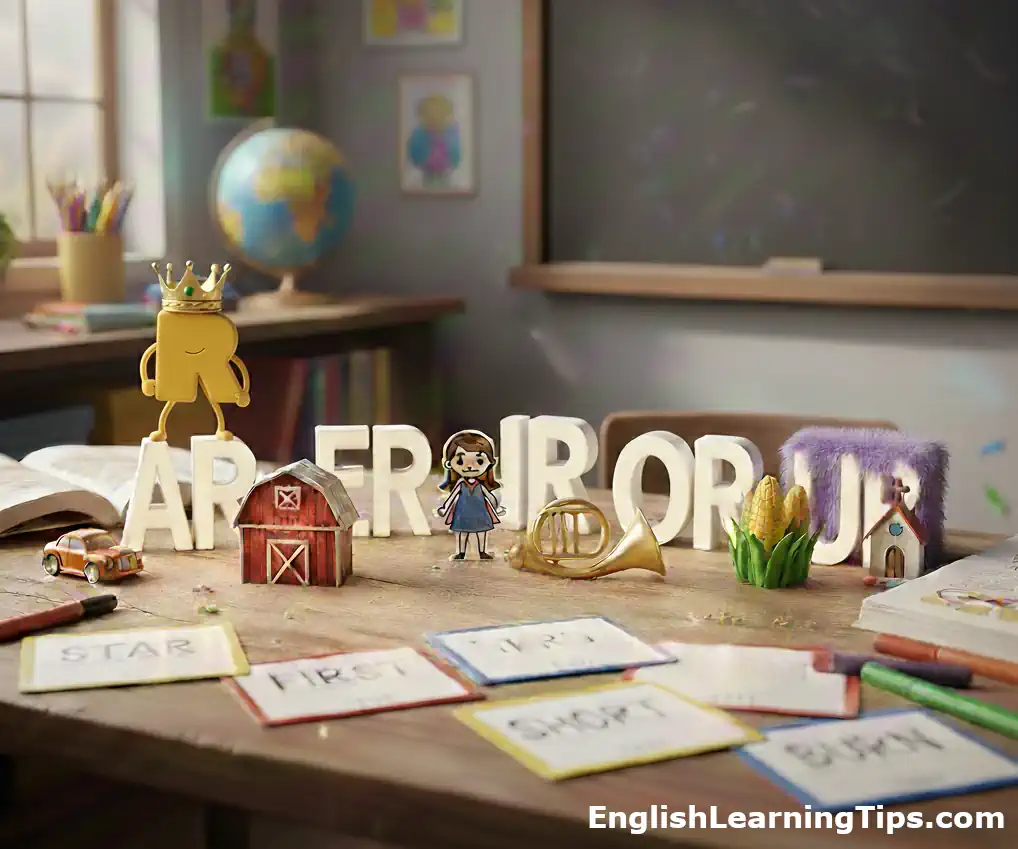
Create a “bossy r” poster. Visual learners benefit from seeing the letter “r” wearing a badge or a crown to signify its control over the vowels.
Pro tip: Use what works, regardless of the student’s age. I’ve seen teachers avoid using “children’s props” when working with adults, but that’s a missed opportunity. Effective teaching is about using the best tools available to make a concept stick. As long as you respect the learner’s maturity, a “bossy r” crown or a visual anchor is simply a smart shortcut to mastery.
3. Practice with word sorts
Give students a list of words and ask them to sort them by their r-controlled ending. This helps them recognize patterns like the ar in “shark” versus the or in “fork.”
4. Listen for the “growl”
Encourage students to listen for the “r” sound at the end of the vowel. If they can hear the “r” blending into the vowel, they are likely dealing with an r-controlled syllable.
Watch out for the “w” and “qu” curveballs
English is full of quirks, and the bossy r has a few specific “enemies” that change its sound:
- The “w” influence: When or follows a w, it usually makes the /er/ sound (e.g., worm, word, world, work).
- The “qu” influence: When ar follows qu, it often makes an /or/ sound (e.g., quart, quarter, quarrel).
Teaching these as “jailbreak” words or special exceptions helps advanced students who have already mastered the basic patterns.
If you are struggling with teaching phonics, consult websites like Reading Rockets or Orton-Gillingham blogs.
Assessing mastery with nonsense words
To see if a student has truly mastered the bossy r, try using “nonsense words.” These are made-up words that follow English phonetic rules. Because the student hasn’t seen them before, they can’t rely on memory; they have to use their knowledge of r-controlled syllables to decode them.
Try these 10 r-controlled nonsense words for a quick check:
| Pattern | Nonsense word | Sounds like… |
| ar | Zarp | Rhymes with harp |
| ar | Varn | Rhymes with barn |
| or | Dorp | Rhymes with fork |
| or | Quorn | Rhymes with born |
| er | Merf | Rhymes with surf |
| er | Slerp | Rhymes with slurp |
| ir | Girt | Rhymes with dirt |
| ir | Flir | Rhymes with stir |
| ur | Thurp | Rhymes with slurp |
| ur | Blurp | Rhymes with burp |
Frequently asked questions about r-controlled vowels
Visual tools to aid in learning
The bossy “r” sounds for kids
Watch this step-by-step breakdown of ‘bossy r’ sounds to help your students hear the difference in real-time.
R-controlled vowel practice
This video may better suit adults.
Teaching bossy “r”
Conclusion: Mastering the bossy r in your classroom
Understanding r-controlled vowels is a huge win for a student’s reading confidence. Once a student can identify how the “bossy r” transforms a simple vowel into a unique sound, their decoding speed and spelling accuracy improve dramatically. While the “ER triplets” (er, ir, and ur) can be tricky because they sound identical, consistent practice with word sorts and visual anchors makes these patterns second nature.
By breaking down these five essential combinations—ar, er, ir, or, and ur—you provide students with the tools they need to tackle multi-syllable words and more complex texts with confidence.
Share your favorite bossy r activities
We want to hear from you! Every educator has a unique way of making phonics “stick.”
- What is your “go-to” game or activity for teaching r-controlled vowels?
- Do you have a creative mnemonic device for the “ER” triplets?
Leave a comment below to share your tips with our community of teachers and parents. If you found this guide helpful, share it on Pinterest or Facebook to help other educators simplify phonics for their students!
Learn more:
Discover more from English Learning Tips
Subscribe to get the latest posts sent to your email.


