
Possessives: A complete guide to ownership in English grammar

Ever found yourself hovering your cursor over an apostrophe, unsure if it belongs before or after the ‘s’? You aren’t alone. Possessives are one of the trickiest parts of English grammar, but getting them right is the fastest way to make your writing look professional.
Possessive adjectives vs. possessive pronouns
One of the most common points of confusion in English grammar is the difference between possessive adjectives (which need a noun) and possessive pronouns (which stand alone).
Possessive adjectives (Dependent)
These function as determiners and must be followed by a noun.
- My: This is my car.
- Your: Is this your coffee?
- His/Her/Its: The tree lost its leaves.
- Our: This is our home.
- Their: I found their lost keys.
Possessive pronouns (Independent)
These replace the noun entirely to avoid repetition.
- Mine: That sandwich is mine.
- Yours: Is this phone yours?
- His/Hers/Its: The victory was hers.
- Ours: The responsibility is ours.
- Theirs: The choice was theirs.
Comparison table: Possessive forms at a glance
| Person | Possessive adjective (Before a noun) | Possessive pronoun (Standalone) |
| 1st Person (Singular) | My | Mine |
| 2nd Person (Singular/Plural) | Your | Yours |
| 3rd Person (Male) | His | His |
| 3rd Person (Female) | Her | Hers |
| 3rd Person (Neutral) | Its | Its |
| 1st Person (Plural) | Our | Ours |
| 3rd Person (Plural) | Their | Theirs |
How to form possessive nouns with apostrophes
Using apostrophes correctly is the most effective way to improve your written English. The rules change based on whether the noun is singular or plural.
Singular nouns
To show possession for a singular person, place, or thing, add ‘s.
- Example: The student’s grade was excellent.
- Example: London’s weather is unpredictable.
Possessive of names ending in s: While some people prefer Chris’, modern usage often leans toward Chris’s. Both are correct—just don’t switch between them in the same piece of writing!
Plural nouns ending in “s”
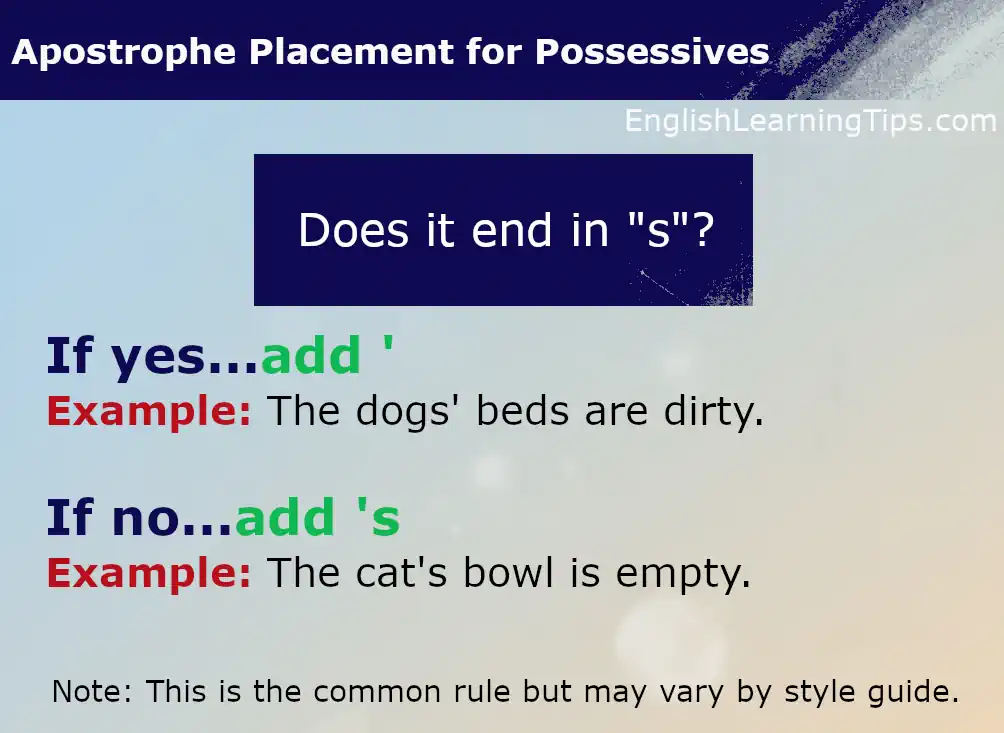
If a noun is already plural and ends in “s,” simply add an apostrophe after the “s.”
- Example: The teachers’ lounge is down the hall (refers to multiple teachers).
- Example: The birds’ nests were high in the trees.
Irregular plural nouns
For plural nouns that do not end in “s,” add ‘s just like a singular noun.
- Example: The children’s toys are everywhere.
- Example: We need to protect people’s rights.
Advanced possessive rules: Compound and joint ownership
Compound nouns
In compound nouns (words made of more than one part), only the last word takes the possessive form.
- Example: My mother-in-law’s garden is beautiful.
- Example: The Postmaster General’s decision was final.
Joint vs. separate possession
This is where things get messy in professional editing. If you’re writing about a couple owning a home, use one apostrophe. If you’re writing about two neighbors with their own homes, use two.
- Joint possession: If two people own the same thing, only the second person gets the apostrophe.
- John and Mary’s house (They live in one house together).
- Separate possession: If two people own different things, both get an apostrophe.
- John’s and Mary’s houses (John has a house, and Mary has a different house).
Special cases in possessive usage
Inanimate objects
While you can use an apostrophe for objects (e.g., “the book’s cover”), many writers prefer the “of” construction for formal contexts.
- Standard: The car’s engine.
- Formal: The engine of the car.
Time and distance
English frequently uses possessives for measurements of time.
- Example: I need a day’s rest.
- Example: It is an hour’s drive from here.
This usage is supported by APA Style’s guidelines for clarity in technical and professional writing.
Pro-tip: The “of” test
If you aren’t sure if a noun should be possessive, try the “of” test.
- The car’s engine → The engine of the car. (Works! Use an apostrophe).
- The cars parked outside → The parked outside of the cars. (Doesn’t work. No apostrophe needed).
Frequently asked questions about possessives
Videos to help aid your understanding
Prefer to learn by watching? Check out these quick breakdowns to see these rules in action.
Possessive adjectives and possessive pronouns
Singular and plural possessive nouns
Possessives for time
Test your knowledge: The possessives challenge
Part 1: Multiple choice
Choose the correct version of each sentence.
- Which sentence correctly uses a possessive pronoun?
- A) That blue jacket is her’s.
- B) That blue jacket is hers.
- C) That blue jacket is her.
- How do you show that two sisters share one bedroom?
- A) The sister’s bedroom.
- B) The sisters’s bedroom.
- C) The sisters’ bedroom.
- Which is the correct way to write a name ending in “s” in modern usage?
- A) Chris’s phone
- B) Chris’ phone
- C) Both are acceptable, as long as you are consistent.
- Identify the correct possessive adjective:
- A) The tree lost it’s leaves in the wind.
- B) The tree lost its leaves in the wind.
- C) The tree lost its’ leaves in the wind.
- If Tom and Jerry own two separate houses, how should you write it?
- A) Tom and Jerry’s houses.
- B) Tom’s and Jerry’s houses.
- C) Toms’ and Jerrys’ houses.
- Which of the following is a “genitive of measure” (time possession)?
- A) Two weeks notice.
- B) Two week’s notice.
- C) Two weeks’ notice.
- How do you make a compound noun like “editor-in-chief” possessive?
- A) The editor’s-in-chief desk.
- B) The editor-in-chief’s desk.
- C) The editor-in-chiefs desk.
- Which sentence uses “it’s” correctly?
- A) It’s been a long day.
- B) The cat licked it’s paw.
- C) I think it’s color is red.
- What is the possessive form of the irregular plural “people”?
- A) Peoples’
- B) Peoples
- C) People’s
- Choose the correct form for a phrase following “else”:
- A) Is this someone else’s bag?
- B) Is this someone’s else bag?
- C) Is this someones else’s bag?
Part 2: Fill in the blank
Complete the sentence with the correct possessive form of the word in parentheses.
- I forgot to bring _________ (I) umbrella today, can I share _________ (you)?
- The _________ (children) playground was recently renovated.
- My _________ (father-in-law) car is parked in the driveway.
- After _________ (three hours) delay, the plane finally took off.
- The _________ (company) new policy was sent out via email.
Answer key
Multiple Choice: 1-B, 2-C, 3-C, 4-B, 5-B, 6-C, 7-B, 8-A, 9-C, 10-A.
Fill in the Blank:
- my / yours
- children’s
- father-in-law’s
- three hours’
- company’s
Summary of possessive rules
Understanding possessives is more than just a grammar exercise; it is a tool for professional and clear communication. Apostrophes shouldn’t be a guessing game. Use this guide whenever you’re stuck on a tricky plural or a confusing compound noun. Once you nail these patterns, your writing will feel much more polished.
What do you think?
Grammar rules can be surprisingly debated! Is there a specific possessive rule that always trips you up, or do you have a trick for remembering where the apostrophe goes?
Leave a comment below with your toughest grammar questions—I would love to help you clear them up. If you found this guide helpful, please share it with a friend or colleague who wants to level up their writing skills!
Discover more from English Learning Tips
Subscribe to get the latest posts sent to your email.


