

English plural rules: A complete guide to singular and plural nouns

Making sense of English plural rules is more than just adding an “s” to the end of a word. If it were that simple, we wouldn’t have to worry about words like geese, indices, or moose. English is a bit of a “linguistic magpie”—it has spent centuries borrowing rules from Latin, Greek, and Old Germanic roots. This is why you’ll find standard patterns sitting right next to total exceptions that seem to defy logic.
Whether you are a student, a professional writer, or someone just looking to sharpen your grammar, this guide breaks down the essential rules. We will start with the basics of singular nouns and work our way through the trickiest irregular forms you’ll encounter.
Key takeaways:
- Most English nouns simply add -s.
- Words ending in -sh, -ch, -x, -z, or -s need -es.
- Irregular nouns like children or sheep don’t follow standard patterns.
What is a singular noun?
To understand plurals, you first need to know how singular nouns behave. A singular noun is a part of speech that names one person, place, thing, or idea. In English, singular nouns often require a “determiner” like a, an, or the to function correctly in a sentence.
- A cat (One specific animal)
- An apple (One piece of fruit)
- The building (A single, specific location)
The relationship between singular and plural forms
The transition from singular to plural is called inflection. Most learners struggle not with the singular form itself, but with knowing which specific rule to apply to transform that base word into its plural counterpart. While the singular form is the “base” (‘lemma‘ for our grammar nerds) that you find in a dictionary, the plural form indicates a change in quantity.
The basic rules of pluralization
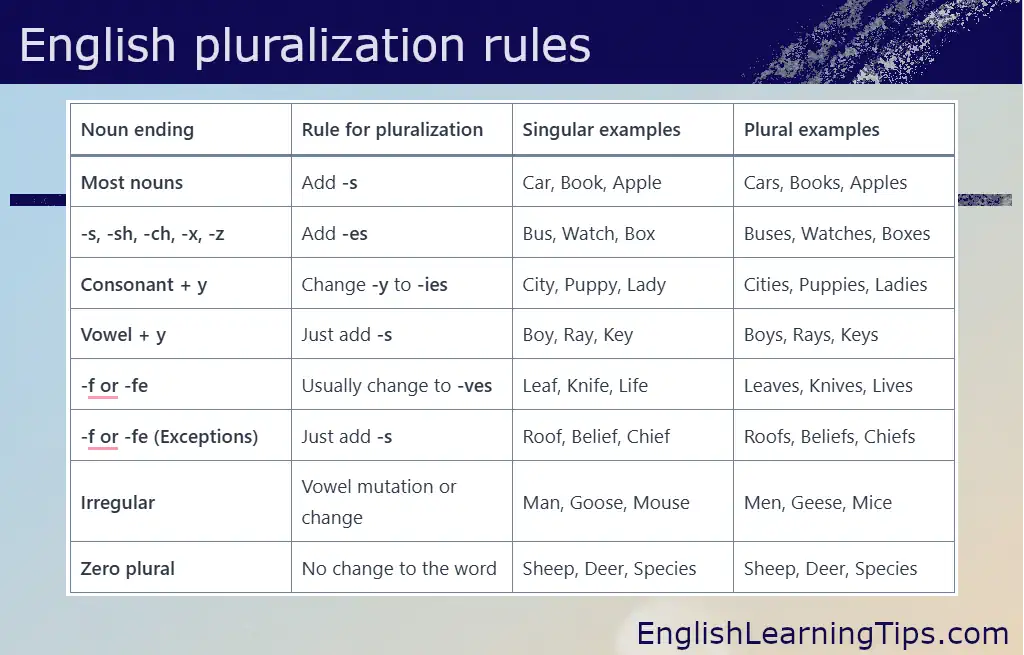
Most English nouns follow predictable patterns. If you are ever in doubt, these four rules cover roughly 90% of the language.
1. The standard plural: Adding -s
For the vast majority of nouns, simply add an -s to the end.
- Car → Cars
- Book → Books
- Apple → Apples
2. Nouns ending in sibilants: Adding -es
If a word ends in a “hissing” sound—specifically -s, -ss, -sh, -ch, -x, or -z—add -es. This makes the word easier to pronounce by adding an extra syllable.
- Bus → Buses
- Watch → Watches
- Box → Boxes
- Quiz → Quizzes (Note: the “z” is doubled here)
3. The “y” ending rule
Look at the letter before the ‘y’ to decide which rule to use.
- Consonant + y: Change the -y to -ies. (e.g., City → Cities, Puppy → Puppies)
- Vowel + y: Just add -s. (e.g., Ray → Rays, Boy → Boys)
4. Nouns ending in -f or -fe
Many nouns ending in -f or -fe change the ending to -ves.
- Leaf → Leaves
- Life → Lives
- Thief → Thieves
Note: There are exceptions like roofs, beliefs, and chiefs which only take an -s.
Quick reference: Common plural noun forms
| Noun category | Singular ending | Plural ending | Examples |
| Standard | Most consonants/vowels | -s | Dog/Dogs, Desk/Desks |
| Sibilants | -s, -sh, -ch, -x, -z | -es | Dish/Dishes, Tax/Taxes |
| Y-Ending | Consonant + y | -ies | Lady/Ladies, Fly/Flies |
| F-Ending | -f or -fe | -ves | Knife/Knives, Wolf/Wolves |
| O-Ending | -o | -s or -es | Photo/Photos, Potato/Potatoes |
Irregular plural nouns and “zero” plurals
Some nouns don’t follow any specific suffix rule. These are often categorized as irregular plurals or mutating plurals.
Common irregulars
- Child → Children
- Person → People
- Mouse → Mice
- Goose → Geese
Zero plurals (unchanging nouns)
Some nouns in the English language are identical in both their singular and plural forms. These are often referred to as base plurals or zero plurals.
- Sheep (One sheep, ten sheep)
- Deer (One deer, a herd of deer)
- Series (One television series, five different series)
- Species (A single species, multiple biological species)
Why this happens
Most of these “zero plurals” come from Old English words that belonged to a specific group of nouns that didn’t take an ending to show plurality. These words have remained unchanged for centuries, surviving from Old English into the modern era.
Latin and Greek plural endings
In academic, scientific, and legal writing, English often retains the original Latin or Greek pluralization.
- -us to -i: Cactus → Cacti, Focus → Foci
- -is to -es: Analysis → Analyses, Crisis → Crises
- -on to -a: Phenomenon → Phenomena, Criterion → Criteria
- -um to -a: Bacterium → Bacteria, Datum → Data
How to pluralize compound nouns
When dealing with hyphenated words or compound nouns, you must identify the principal word (the most important noun) and pluralize that, rather than the end of the phrase.
- Mother-in-law → Mothers-in-law (The “mothers” are plural, not the “law”)
- Editor-in-chief → Editors-in-chief
- Passerby → Passersby
Frequently asked questions about English plurals
Videos to help you learn
Singular vs plural
Singular or plural? Confusing nouns (British English)
Test your knowledge: The English plural rules quiz
Think you have mastered the transition from singular to plural? Take our quick quiz to find out.
Part 1: Multiple choice
Choose the correct plural form for each singular noun.
- What is the plural of “Potato”? a) Potatos b) Potatoes c) Potaties
- What is the plural of “Crisis”? a) Crisises b) Crisi c) Crises
- Which is the correct plural for “Knife”? a) Knifes b) Knives c) Knivs
- What is the plural of “Analysis”? a) Analyses b) Analysises c) Analysi
- Which form is correct for “Attorney-at-law”? a) Attorney-at-laws b) Attorneys-at-law c) Attorneys-at-laws
- What is the plural of “Phenomenon”? a) Phenomenas b) Phenomenons c) Phenomena
- How do you pluralize the abbreviation “CEO”? a) CEO’s b) CEOs c) Ceoes
- What is the plural of “Mouse” (the animal)? a) Mouses b) Mice c) Meese
- Which word remains the same in both singular and plural? a) Cactus b) Species c) Church
- What is the plural of “Roof”? a) Rooves b) Roofes c) Roofs
Part 2: Fill-in the blank
Write the correct plural form of the noun provided in parentheses.
- There are several different __________ (species) of birds in this forest.
- All three of my __________ (brother-in-law) are coming to the dinner.
- We need to collect more __________ (datum) before we can finish the report.
- The __________ (child) played happily in the park all afternoon.
- I saw three __________ (deer) crossing the road at sunrise.
Answer key
Check your scores below to see how well you know your pluralization rules.
- b) Potatoes (Nouns ending in -o often take -es)
- c) Crises (Latin/Greek -is changes to -es)
- b) Knives (-fe changes to -ves)
- a) Analyses (Greek origin ending)
- b) Attorneys-at-law (Pluralize the principal noun)
- c) Phenomena (Greek -on changes to -a)
- b) CEOs (No apostrophe needed for plural abbreviations)
- b) Mice (Irregular mutation)
- b) Species (A zero plural noun)
- c) Roofs (An exception to the -f/-ves rule)
- Species
- Brothers-in-law
- Data
- Children
- Deer
Perfecting your English plurals: Final thoughts
While the rules of English plurals can seem inconsistent, they follow a historical logic that becomes easier to recognize with practice. Start by mastering the high-frequency rules—like adding -s or -es—before moving on to the more specialized Latin and Greek forms. Consistency is the key to professional writing, so when in doubt, choose the most modern and widely accepted form for your specific audience.
Join the conversation: What is the trickiest plural you have encountered?
Grammar is an evolving landscape, and we want to hear from you! Do you prefer “octopuses” or “octopi”? Is there a specific word that always trips you up when you try to pluralize it?
Leave a comment below with your toughest plural noun or any questions you have about these rules. Our community of language lovers is here to help you get it right every time.
Discover more from English Learning Tips
Subscribe to get the latest posts sent to your email.


