

How to form negative sentences in English: A complete grammar guide

Negative sentences are a cornerstone of English communication. We use them to deny information, refuse requests, or describe the absence of an action. While the basic rule involves adding “not,” the placement changes depending on whether you are using the verb “to be,” auxiliary verbs, or modal verbs.
This guide breaks down the rules for every major tense so you can stop second-guessing your grammar and start speaking with confidence.
How do you make a sentence negative in English?
To make a sentence negative, you generally follow this simple rule: Place the word “not” after the first auxiliary (helping) verb. If there is no auxiliary verb (like in the present simple), use do, does, or did as a placeholder.
Common structures for negative sentences
In most cases, the formula for a negative sentence is:
Subject + Auxiliary/Modal Verb + Not + Main Verb
Using the verb “to be”
When “be” is the main verb, you do not need an auxiliary verb like “do.” Simply place “not” after the conjugated form of ‘be’
| Tense | Subject | Verb + not | Example |
| Present | I | am not | I am not ready. |
| Present | He/She/It | is not (isn’t) | She isn’t here. |
| Present | You/We/They | are not (aren’t) | They aren’t home. |
| Past | I/He/She/It | was not (wasn’t) | He wasn’t at work. |
| Past | You/We/They | were not (weren’t) | We weren’t late. |
Negative sentences with “do,” “does,” and “did”
For most other verbs in the present simple and past simple, you must use the auxiliary verb “do.”
- Present simple: Use “do not” (don’t) or “does not” (doesn’t).
- I do not like coffee.
- He does not like coffee. (Note: The main verb “like” loses the “s” when “does” is used).
- Past simple: Use “did not” (didn’t) for all subjects.
- They did not go to the concert.
How to use modal verbs in negative sentences
Modal verbs (can, should, will, must, etc.) follow a simple pattern: just add “not” immediately after the modal.
- Can: I cannot (can’t) swim. (Note: “cannot” is written as one word).
- Should: You should not (shouldn’t) eat that.
- Will: They will not (won’t) attend the event.
- Must: We must not (mustn’t) forget the keys.
Negatives in continuous and perfect tenses
For complex tenses, the word “not” always follows the first auxiliary verb.
Present and past continuous
- Present continuous: She is not eating dinner now.
- Past continuous: They were not playing outside.
Present perfect
- Standard: I have not (haven’t) seen that movie.
- Third person: She has not (hasn’t) finished her homework.
Negative imperatives: Giving commands
To tell someone not to do something, start the sentence with “do not” or “don’t,” regardless of the main verb.
- Do not touch that.
- Don’t worry.
- Don’t be late.
Essential rules for English negatives
To speak and write correctly, keep these three professional tips in mind:
- Avoid double negatives: In standard English, two negatives cancel each other out. Instead of saying “I don’t have nothing,” say “I don’t have anything” or “I have nothing.”
- Contractions vs. full forms: Use contractions (don’t, won’t, hasn’t) for casual conversation and emails. Use full forms (do not, will not, has not) for formal essays or business reports.
- The “any” rule: When a sentence becomes negative, words like “some” usually change to “any.”
- Affirmative: I have some water.
- Negative: I do not have any water.
Negative adverbs: Making a sentence negative without “not”
You don’t always need the word “not” to create a negative meaning. English uses negative adverbs to express that an action happens almost never or to a very small degree.
Common negative and semi-negative adverbs
- Never: I never eat meat. (100% negative)
- Rarely / Seldom: She rarely visits the city. (Almost never)
- Hardly / Scarcely / Barely: I hardly know him. (Almost not at all)
The “negative inversion” rule
When you start a sentence with a negative adverb to add emphasis, it triggers subject-auxiliary inversion, where the verb comes before the subject.
| Standard structure | Inverted structure (for emphasis) |
| I have never seen such beauty. | Never have I seen such beauty. |
| He seldom leaves his house. | Seldom does he leave his house. |
| We had hardly arrived when it rained. | Hardly had we arrived when it rained. |
Pro tip: Inversion makes your writing sound more formal and dramatic. It is rarely used in casual conversation but is highly effective in literature and public speaking.
Negative pronouns and determiners
Using negative pronouns is another way to negate a sentence without the standard “auxiliary + not” construction.
- None: None of the students passed.
- Neither: Neither of the plans worked.
- No: I have no money. (This is often more emphatic than saying “I don’t have any money.”)
Asking negative questions
Sometimes we use negatives to ask for confirmation or express surprise.
- Contracted (Informal): Doesn’t she live here?
- Uncontracted (Formal): Does she not live here?
Note: When you don’t use a contraction, “not” comes after the subject.
Frequently asked questions about negative sentences
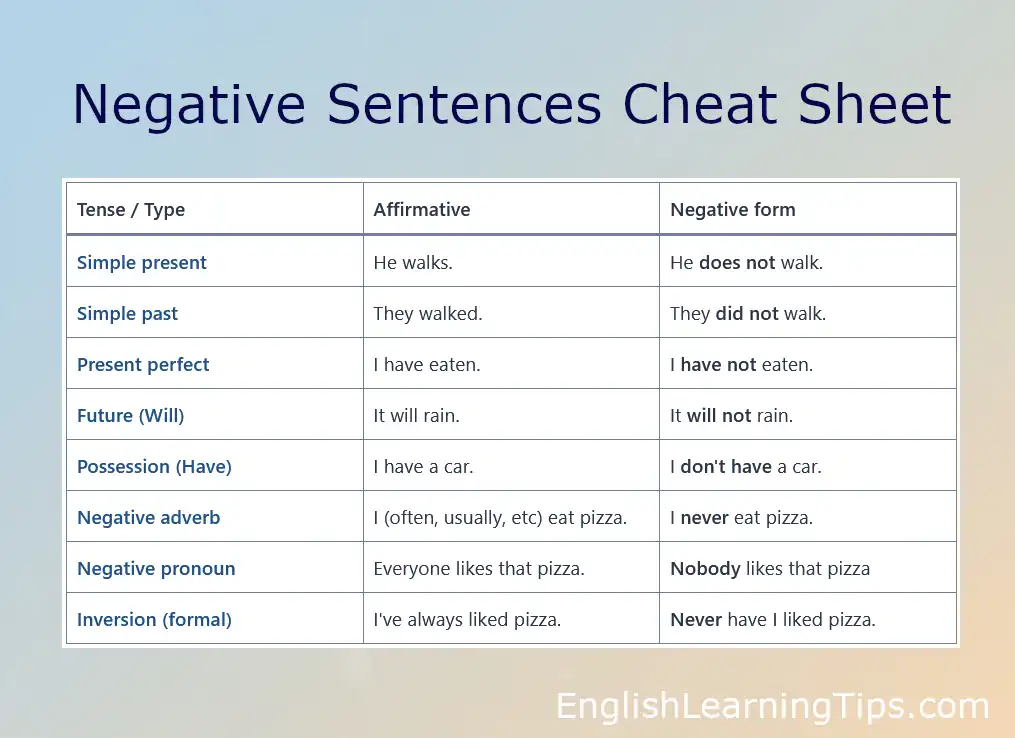
Quick summary of making negative sentences
Videos to help you learn
Making negative sentences
No, not, don’t, doesn’t, didn’t
Double negatives in English
Test your knowledge: The negative sentences quiz
How well do you know your English negatives? Select the correct negative form for each sentence below.
1. Affirmative: “She plays the piano.”
- a) She not plays the piano.
- b) She doesn’t plays the piano.
- c) She doesn’t play the piano.
2. Affirmative: “We were happy.”
- a) We weren’t happy.
- b) We didn’t be happy.
- c) We was not happy.
3. Which sentence is grammatically correct in standard English?
- a) I don’t have nothing.
- b) I don’t have anything.
- c) I have not nothing.
4. Affirmative: “They have finished.”
- a) They don’t have finished.
- b) They haven’t finished.
- c) They have finished not.
5. Affirmative: “I can swim.”
- a) I can’t swim.
- b) I don’t can swim.
- c) I cannot to swim.
6. Change this imperative to negative: “Open the door.”
- a) Not open the door.
- b) Open not the door.
- c) Don’t open the door.
7. Affirmative: “He went to school.”
- a) He didn’t went to school.
- b) He didn’t go to school.
- c) He not go to school.
8. Affirmative: “I am eating.”
- a) I’m not eating.
- b) I don’t eating.
- c) I am no eating.
9. Choose the correct formal negative:
- a) You shouldn’t do that.
- b) You should not do that.
10. Affirmative: “There is some milk.”
- a) There isn’t some milk.
- b) There isn’t any milk.
- c) There is no any milk.
Answer key
- C (Main verb loses the ‘s’)
- A (Plural past tense of ‘be’)
- B (Avoids double negatives)
- B (Present perfect negative)
- A (Modal verb contraction)
- C (Negative imperative)
- B (Past simple uses ‘did’ + base verb)
- A (Present continuous negative)
- B (Full forms are used in formal writing)
- B (‘Some’ changes to ‘any’ in negatives)
Mastering negatives in your daily English
Forming negative sentences is more than just adding “not”—it is about choosing the right auxiliary verb and maintaining the correct word order. Whether you are using a casual “don’t” in conversation or practicing complex negative inversion for an essay, consistency is what makes your English sound natural.
By mastering these rules, you eliminate common errors like double negatives and “double marking” (e.g., “he doesn’t like” instead of “he doesn’t likes”), helping you communicate your ideas clearly and professionally.
What do you find hardest about English negatives?
Grammar can be tricky, and even advanced learners sometimes trip up on negative questions or semi-negative adverbs like “hardly.”
Now, we want to hear from you: * Which of the rules above was new to you?
- Is there a specific sentence you’re struggling to turn into a negative?
Drop a comment below with your questions or a practice sentence, and we’ll help you check it! If you found this guide helpful, consider sharing it with a fellow student or colleague.
Discover more from English Learning Tips
Subscribe to get the latest posts sent to your email.


