

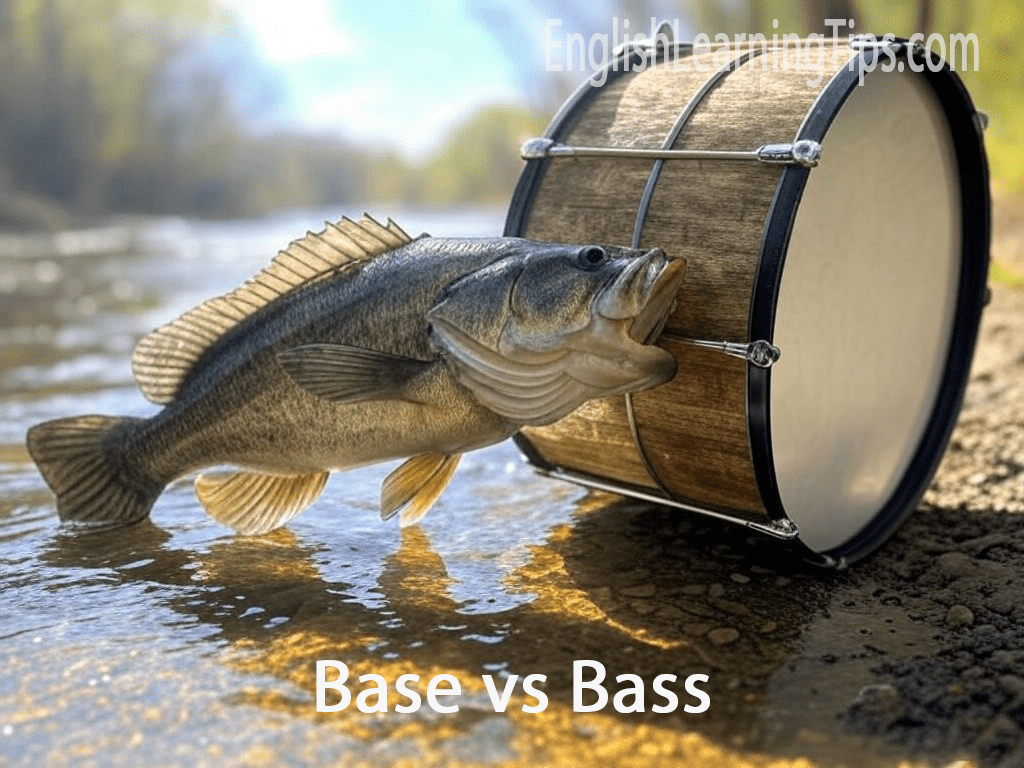
Base vs. bass: How to use these confusing homophones correctly

The English language is full of homophones—words that sound identical but have different meanings. Among the most common culprits are base and bass. Whether you are talking about a foundation, a musical instrument, or your latest fishing trip, using the wrong spelling can change the entire meaning of your sentence.
In this guide, we break down the definitions, pronunciations, and grammar rules for base vs. bass to help you write with confidence.
What is the difference between base and bass?
The primary difference lies in their usage. Base refers to a foundation or starting point. Bass (pronounced like base) refers to low-frequency sounds or instruments. Bass (pronounced like sass) refers to several species of fish.
Quick reference table
| Word | Pronunciation | Common meanings | Example sentence |
| Base | Bay-ss | Foundation, HQ, chemical alkaline | “The lamp has a heavy metal base.” |
| Bass (Music) | Bay-ss | Low tones, guitar, deep voice | “The bass player kept the rhythm.” |
| Bass (Fish) | Ba-ss | Sea bass, largemouth bass | “We caught a huge bass at the lake.” |
When to use base
The word base acts as a noun, verb, and occasionally an adjective. It almost always relates to a “bottom” or “starting point.”
1. As a noun: Foundation
- Architecture: The bottom support of a structure.
- Mathematics: The number that serves as the building block for a counting system (e.g., base 10).
- Chemistry: A substance with a pH greater than 7 that neutralizes acid.
- Military: A center of operations (e.g., an air base).
2. As a verb: To establish
To “base” something means to use a specific location or idea as a starting point for further development.
- Example: “I decided to base my thesis on the latest economic data.”
3. As an adjective: Morality
In literature, “base” can describe something low-quality, dishonorable, or ignoble.
- Example: “He was driven by base instincts rather than logic.”
When to use bass
The word bass is a heteronym—a word that is spelled the same but has two different pronunciations and meanings.
1. The musical bass: Pronounced like “base”
This refers to the lowest range of pitch. It applies to:
- Voices: The lowest male singing voice.
- Instruments: The bass guitar, upright bass, or the low-end frequencies on a speaker.
- Notation: The bass clef used in sheet music to denote lower notes.
2. The fish bass: Pronounced like “sass”
This refers to various species of perch-like fish found in both fresh and saltwater.
- Example: “Striped bass are a popular target for Atlantic fishermen.”
Frequently asked questions about base and bass
Tips to remember the difference
- The “E” rule: Think of the “e” in base as standing for Everything starts at the bottom.
- The “SS” rule: Think of the double “s” in bass as standing for Sub-woofer (music) or Sea creature (fish).
By keeping these simple distinctions in mind, you can avoid common writing errors and ensure your message is clear to your readers.
A video to help with meaning and pronunciation
Join the conversation: What is your trick?
Did you grow up pronouncing these words differently, or did a specific mnemonic help you remember the spelling of bass guitar? We want to hear from you!
Leave a comment below with:
- The most confusing homophone pair you have encountered.
- Any tricks you use to remember the difference between “base” and “bass.”
- A funny “auto-correct” fail you have had involving these words.
Your insights help other readers learn, and we love hearing your linguistic “fish stories!”
Discover more from English Learning Tips
Subscribe to get the latest posts sent to your email.


